Automation Ready Template
Synthesis of Zinc Manganese Oxide (ZnMnO₃) Nanoparticles and its Characterization
Abstract
This protocol aims to synthesize zinc manganese oxide nanomaterial with controlled composition, reproducibility, and functional properties for advanced material applications. The objective is to prepare a stable mixed metal oxide system by combining zinc and manganese precursor salts under controlled reaction conditions. The method involves preparing aqueous precursor solutions, continuous stirring for uniform mixing, gradual pH adjustment using an alkaline agent, controlled heating to promote oxide formation, followed by washing, separation, drying, and optional calcination to improve crystallinity. The protocol also includes key checkpoints such as color change, precipitate formation, and post-synthesis recovery.
The significance of this protocol lies in its usefulness for preparing zinc manganese oxide materials for catalysis, energy storage, sensing, environmental remediation, and electrochemical studies. By structuring the workflow in Protoly, the synthesis can be standardized, parameterized, and optimized for better reproducibility and future automation-ready experimental planning.
Keywords
Graphical Abstract
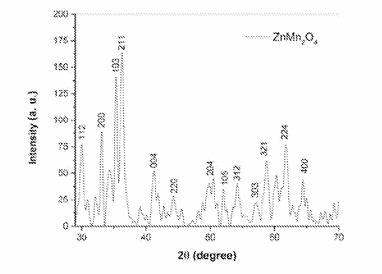
Introduction
Zinc manganese oxide is a mixed metal oxide material that combines the functional characteristics of zinc-based and manganese-based oxide systems. Such materials are of growing interest because they can exhibit useful structural, catalytic, electrochemical, and sensing properties depending on their composition, morphology, crystallinity, and synthesis conditions. In nanomaterial research, mixed oxides are often preferred over single-metal oxides because the interaction between two metal centres can improve charge transfer, surface reactivity, stability, and application-specific performance. Zinc manganese oxide has potential relevance in areas such as energy storage, environmental remediation, photocatalysis, biosensing, chemical sensing, and advanced functional materials.
The motivation for developing this protocol is to establish a reproducible and parameter-controlled method for preparing zinc manganese oxide using a wet-chemical synthesis route. Conventional synthesis procedures often vary in precursor concentration, pH, temperature, stirring conditions, drying, and calcination, which can affect particle formation and final material properties. By structuring the workflow in Protoly, each step can be clearly defined, including precursor preparation, controlled mixing, pH adjustment, heating, precipitation, washing, drying, and optional calcination. This helps improve standardization, repeatability, and optimization of the synthesis process. The protocol also supports systematic variation of reaction parameters, making it useful for research, training, and future automation-ready nanomaterial synthesis.
Automation Materials
- Zinc 2x
Automation Workflow (1 group and 6 steps)
0. Continuous (1 step)
Stirrer
Sterilization UV
Liquid Addition
Liquid dispensing from a calibrated reservoir channel
Liquid Addition
Liquid dispensing from a calibrated reservoir channel
Heater
5. Heating and Electro-chemical Module Group (2 steps)
Heater
Electrochemical Voltage
Apply voltage or current to an electrochemical system.
Wait
Discussion
Zinc manganese oxide is significant because it combines the functional properties of zinc oxide and manganese oxide into a mixed metal oxide system with improved structural, surface, and electrochemical behavior. The presence of two metal centres can enhance charge transfer, surface reactivity, catalytic activity, and material stability compared with single-component oxides. In this protocol, the synthesis of zinc manganese oxide through a controlled wet-chemical route allows systematic control over precursor concentration, pH, temperature, stirring time, and post-synthesis treatment, which are important for obtaining reproducible material properties.
The main advantages of this protocol include its simplicity, low cost, aqueous reaction medium, scalability, and suitability for parameter optimization. It can be easily structured in Protoly as a stepwise workflow, making it useful for reproducible synthesis, training, and automation-ready experimental planning. The method also allows modification of reaction conditions to tune morphology, crystallinity, particle size, and functional performance.
However, the protocol has some limitations. The final material properties may be highly sensitive to pH, precursor ratio, heating conditions, and calcination temperature. Without proper control, the product may show mixed phases, irregular particle size distribution, aggregation, or poor crystallinity. Additional characterization such as XRD, SEM, FTIR, UV-Vis, and electrochemical analysis is required to confirm successful synthesis and evaluate performance.
Potential applications of zinc manganese oxide include energy storage devices, supercapacitors, batteries, photocatalysis, environmental pollutant degradation, chemical sensors, biosensors, antimicrobial materials, and catalytic systems. Because of its mixed oxide nature, it is also useful for advanced materials research where tunable composition and surface activity are required.
Figure 1 . TEM of Zinc Manganese Oxide
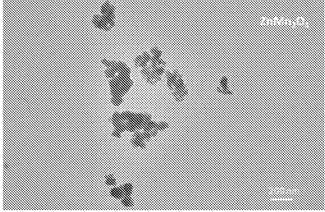
It shows the TEM of Zinc Manganese Oxide nanoparticles. It clearly shows the nanoparticles with average particle size of 80 nanometer.
Conclusion
This protocol provides a structured approach for synthesizing zinc manganese oxide nanomaterial using controlled precursor mixing, pH adjustment, heating, stirring, washing, drying, and optional calcination. Key parameters such as precursor ratio, temperature, pH, reaction time, and post-treatment conditions can be systematically adjusted to influence particle formation, crystallinity, morphology, and functional performance. By organizing the synthesis workflow in Protoly, the protocol supports reproducibility, standardization, optimization, and future automation-ready experimental planning.
The potential impact of this protocol lies in its ability to simplify and standardize mixed metal oxide synthesis for research, training, and applied material development. Zinc manganese oxide has relevance in energy storage, catalysis, sensing, environmental remediation, and electrochemical applications. A well-defined digital protocol can reduce experimental ambiguity, improve repeatability across users or laboratories, and support systematic comparison of synthesis conditions, making it valuable for both academic research and scalable nanomaterial development.
Conflict of Interest
The authors declare no area of conflict.