Automation Ready Template
Synthesis of Iron oxide (Fe₃O₄) nanoparticles and its characterization (TEM)
Abstract
The objective of this protocol is to synthesize iron oxide nanoparticles with controlled size and morphology using a co-precipitation approach. The synthesis involves the reaction of ferric and ferrous iron precursors in an aqueous medium, followed by the gradual addition of a base to induce nanoparticle formation under controlled pH and temperature conditions. Continuous stirring and optimized reaction parameters promote uniform nucleation and growth of the particles. The nanoparticles are then separated, thoroughly washed to remove residual ions and impurities, and dried for storage or further analysis.
The resulting nanoparticles are expected to exhibit nanoscale dimensions, high purity, and characteristic magnetic behavior. Their structural, morphological, and magnetic properties can be evaluated using analytical techniques such as X-ray diffraction (XRD), scanning electron microscopy (SEM), transmission electron microscopy (TEM), and vibrating sample magnetometry (VSM). Iron oxide nanoparticles produced through this method are suitable for a broad range of applications, including environmental remediation, magnetic separation, catalysis, bio sensing, biomedical imaging, targeted drug delivery, and advanced materials research. The protocol offers a simple, cost-effective, and scalable route for the reproducible synthesis of high-quality iron oxide nanoparticles in laboratory and industrial settings.
Keywords
Introduction
Iron oxide nanoparticles, particularly magnetite (Fe₃O₄) and maghemite (γ-Fe₂O₃), are widely utilized across multiple disciplines. Their superparamagnetic behavior, large surface area, and ability to be functionalized with a variety of chemical and biological molecules make them attractive candidates for applications in biomedical imaging, targeted drug delivery, biosensing, magnetic separation, catalysis, environmental remediation, and energy storage technologies. In environmental applications, IONPs have demonstrated significant potential for the adsorption and removal of pollutants from water, while in medicine they are increasingly explored as contrast agents and carriers for therapeutic compounds.
The growing demand for high-quality iron oxide nanoparticles has driven the development of numerous synthesis strategies, including hydrothermal, sol-gel, thermal decomposition, microemulsion, and co-precipitation methods. Among these approaches, co-precipitation remains one of the most widely adopted techniques because it is simple, cost-effective, scalable, and capable of producing nanoparticles under relatively mild reaction conditions. The method relies on the controlled precipitation of ferrous and ferric ions in an alkaline medium, resulting in the formation of iron oxide nanostructures.
This protocol is motivated by the need for a reliable and reproducible procedure for synthesizing iron oxide nanoparticles suitable for research and educational applications. By carefully controlling reaction parameters such as pH, temperature, precursor concentration, and mixing conditions, the protocol aims to produce nanoparticles with desirable size, morphology, and magnetic properties. The resulting material can be further characterized using standard analytical techniques and utilized in a broad range of nanotechnology and materials science investigations.
Automation Materials
- Deionized Water 3x
- Ammonium Hydroxide 2x
- Ethanol
Automation Workflow (4 groups and 3 steps)
1. Precursor preparation (2 steps)
Liquid Addition
Dissolve 0.994 g Fe²⁺ salt in 30 mL Deionized Water .
Liquid Addition
Dissolve 2.703 g Fe³⁺ salt in 70 mL Deionized Water .
2. Inert Gas Purging (2 steps)
Inert Gas Purging
Bubble nitrogen (N₂) gas through the iron precursor solution for 30 minutes while stirring to remove dissolved oxygen and maintain an oxygen-free environment. This prevents oxidation of Fe²⁺ ions and promotes the formation of magnetite (Fe₃O₄) nanoparticles.
Stirrer
Continuously stir the solution at 400 rpm for a duration of 30 min while purging the nitrogen gas to achieve deoxygenation.
3. Precipitation (2 steps)
Stirrer
Under vigorous magnetic stirring (700 rpm), add 25% Ammonium Hydroxide solution dropwise to the deoxygenated iron precursor mixture until the pH reaches 10. Continue stirring to ensure complete precipitation and uniform nanoparticle formation.
Addition of Ammonium Hydroxide (NH₄OH)
Under vigorous magnetic stirring (700 rpm), add 25% Ammonium Hydroxide solution dropwise to the deoxygenated iron precursor mixture until the pH reaches 10.
4. Heating and Stirring (2 steps)
Heater
Stirring at elevated temperature (80 C) for 30-50 min allows crystal growth and phase stabilization.
Stirrer
Continuous stirring at 500 rpm for 50 minutes to facilitate crystal growth and improve crystallinity at 80 C temperature.
Magnetic Separation
Place the reaction vessel on a strong magnet. The nanoparticles will collect at the bottom, allowing you to decant the supernatant liquid.
Washing
Wash the settled nanoparticles 5 times with Deionized Water and 3 times with Ethanol .
Drying
Dry the purified nanoparticles in a vacuum oven or at room temperature to obtain a fine powder.
Discussion
The synthesis of iron oxide (Fe₃O₄) nanoparticles and their characterization using Transmission Electron Microscopy (TEM) is an important area of nanotechnology research due to the unique magnetic, chemical, and surface properties of these nanomaterials. Fe₃O₄ nanoparticles are commonly synthesized through methods such as co-precipitation, thermal decomposition, hydrothermal synthesis, and solvothermal techniques, with co-precipitation being widely preferred because of its simplicity, low cost, and scalability. TEM plays a crucial role in characterizing these nanoparticles by providing high-resolution images that reveal their size, shape, morphology, and degree of aggregation, enabling researchers to assess synthesis quality and nanoparticle uniformity. The significance of Fe₃O₄ nanoparticles lies in their superparamagnetic behavior, biocompatibility, and high surface-area-to-volume ratio, making them valuable in diverse scientific and industrial fields. Their advantages include easy magnetic separation, tunable surface chemistry, relatively low toxicity, and cost-effective production. However, they also have limitations such as a tendency to aggregate due to magnetic interactions, susceptibility to oxidation under certain conditions, and challenges in achieving precise size control during synthesis. Despite these limitations, Fe₃O₄ nanoparticles have numerous applications, including targeted drug delivery, magnetic resonance imaging (MRI) contrast enhancement, biosensing, wastewater treatment, environmental remediation, magnetic data storage, catalysis, and magnetic hyperthermia for cancer therapy. Their versatile properties continue to drive research and development, highlighting their importance in advancing nanomedicine, environmental technology, and materials science.
Figure 1
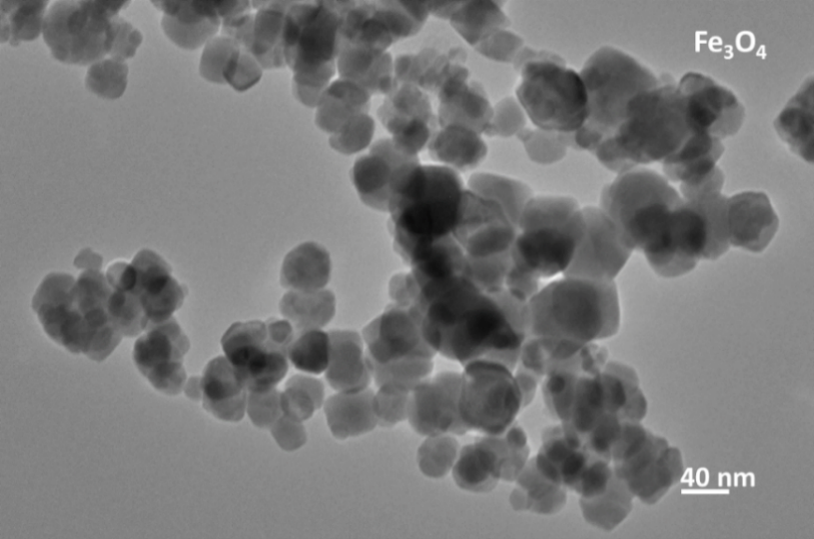
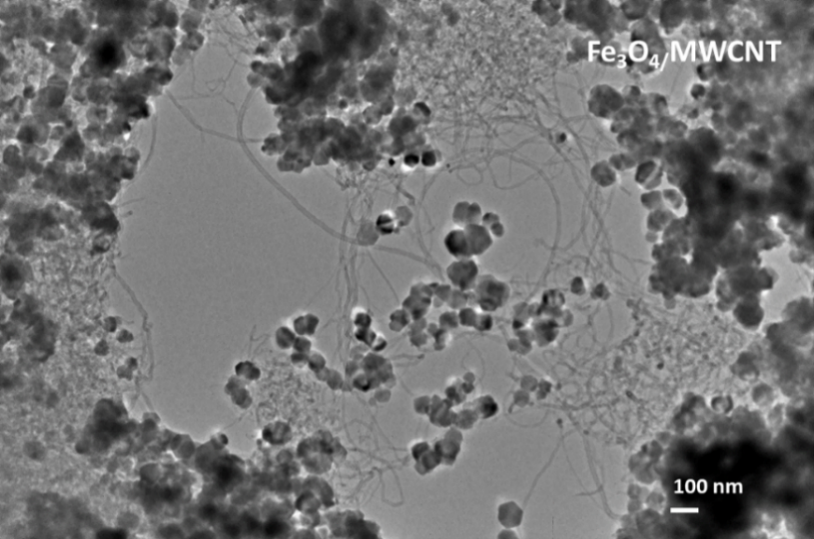
Figure 2
Conclusion
The protocol for the synthesis and TEM characterization of iron oxide (Fe₃O₄) nanoparticles provides an efficient and reliable approach for producing magnetic nanomaterials with controlled size and morphology. By combining a straightforward synthesis method with high-resolution TEM analysis, the protocol enables accurate evaluation of nanoparticle quality and structural properties. The key outcomes include the successful formation of Fe₃O₄ nanoparticles, determination of their size and shape, and assessment of their dispersion and crystallinity. The potential impact of this protocol is significant, as it supports the development of advanced materials for biomedical applications such as drug delivery and MRI imaging, environmental applications including water purification and pollutant removal, and industrial uses such as catalysis and magnetic separation. Furthermore, the protocol serves as a foundation for future research aimed at optimizing nanoparticle performance, improving synthesis reproducibility, and expanding the practical applications of magnetic nanomaterials in science and technology.
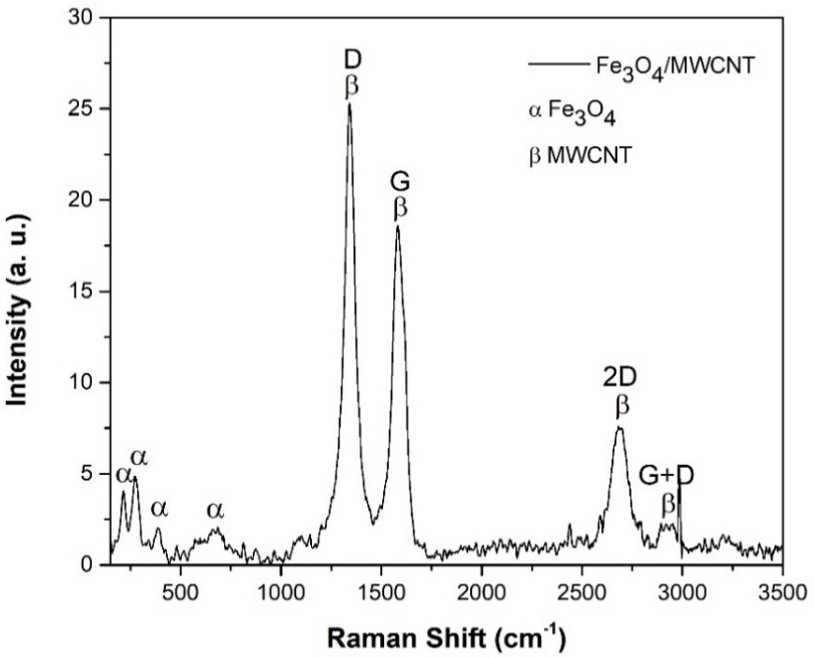
Figure 3
Conflict of Interest
The authors declare no conflict of interest statement.