Automation Ready Template
Synthesis of Urchin like surface morphology copper oxide (CuO) nanoparticles
Abstract
This protocol describes the synthesis of copper oxide nanoparticles, classified as a copper-based inorganic nanomaterial, using a simple wet-chemical precipitation approach. The objective is to prepare stable CuO nanoparticles in a controlled laboratory-scale process for further use in catalytic, antimicrobial, sensing, electrochemical, or environmental studies. The significance of this protocol lies in its simplicity, low cost, reproducibility, and suitability for producing functional metal oxide nanoparticles with high surface area and useful physicochemical properties.
In this method, an aqueous copper salt solution, such as copper nitrate, copper sulfate, or copper acetate, is prepared and stirred continuously. A basic reagent, commonly sodium hydroxide, is added dropwise to increase the pH and form copper hydroxide intermediates. The reaction mixture is then heated under stirring to promote conversion into copper oxide nanoparticles. The precipitate is collected by centrifugation or filtration, washed with distilled water and ethanol to remove impurities, and dried. Optional calcination may be performed to improve crystallinity and obtain the final CuO nanoparticle powder.
Keywords
Introduction
Copper oxide nanoparticles are an important class of copper-based inorganic nanomaterials widely studied because of their unique physical, chemical, optical, antimicrobial, catalytic, and electrochemical properties. Copper oxide mainly exists in two common forms, cupric oxide (CuO) and cuprous oxide (Cu₂O), both of which show promising nanoscale behavior compared with their bulk counterparts. Due to their small particle size, high surface-area-to-volume ratio, and reactive surface chemistry, copper oxide nanoparticles are useful in several fields, including catalysis, biosensing, antimicrobial coatings, environmental remediation, energy storage, and biomedical research.
The context of this protocol is based on the need for a simple, reproducible, and cost-effective method to synthesize copper oxide nanoparticles under laboratory conditions. Wet-chemical precipitation is commonly preferred because it does not require highly complex instruments, expensive precursors, or harsh reaction conditions. In this method, a copper salt acts as the copper source, while a base such as sodium hydroxide helps in the formation of copper hydroxide intermediates. Controlled heating, stirring, washing, drying, and optional calcination help convert the intermediate into stable copper oxide nanoparticles.
The motivation behind this protocol is to develop a reliable synthesis workflow that can produce copper oxide nanoparticles with suitable purity, stability, and functional properties for further studies. Such a protocol is useful for researchers who need a standard nanoparticle synthesis process for characterization and application-based experiments. By controlling parameters such as precursor concentration, pH, temperature, reaction time, and calcination conditions, the size, morphology, crystallinity, and performance of the nanoparticles can be optimized. Therefore, this protocol provides a practical foundation for preparing copper oxide nanoparticles for catalytic, antimicrobial, sensing, electrochemical, and environmental applications.
Automation Materials
- Deionized Water
- Sodium Hydroxide
- Urea
- Ethanol
Automation Workflow (2 groups and 6 steps)
1. Reservoir dispense and stirrer (2 steps)
Liquid Addition
Deionized Water 24.16g of copper II nitrate trihydrate is mixed with 1000ml of deionized water to make 1M solution.
Stirrer
Stirring to make a precursor solution
heat and add base
Sodium Hydroxide Heat the copper solution 70 to 80*c on a magnetic hotplate. Slowly add the 0.2 M NaOH solution dropwise while stirring vigorously.
Adjust the pH
Monitor the pH of the mixture during the NaOH addition. Stop the dropwise addition once the pH reaches 10.0. A dark blue or dark brown precipitate (Copper Hydroxide, Cu(OH)2) will begin to form.
4. Heating and Stirring (2 steps)
Stirrer
Maintain the mixture at 70^C to 80^C with continuous, vigorous stirring for 4 hours to ensure the reaction goes to completion.
Heater
Centrifugation
centrifuge at 3000 rpm for 30 min to separate out the nanoparticles.
wash and recover
Turn off the heat and allow the solution to cool to room temperature. The precipitate will settle to the bottom. Filter the mixture using vacuum filtration. Wash the collected precipitate 4 to 5 times with distilled water, followed by a final rinse in Ethanol , to remove any soluble impurities.
Heater
dry the product .
Calcine
Grind the dried powder in an agate mortar and calcinate in a muffle furnance at 400*C for 2 hours.
Discussion
Copper oxide nanoparticles (CuO NPs) are highly significant in modern materials science because they combine the useful chemical properties of copper oxide with the unique advantages of nanoscale materials. Due to their small particle size and high surface-area-to-volume ratio, CuO nanoparticles show enhanced reactivity, improved catalytic behavior, and stronger interaction with biological and environmental systems compared with bulk copper oxide. Their synthesis is important for developing low-cost functional nanomaterials for healthcare, agriculture, energy, sensors, and environmental remediation.
One major advantage of synthesizing CuO nanoparticles is that copper is relatively inexpensive, easily available, and less costly than noble metals such as silver, gold, or platinum. CuO nanoparticles can be prepared using several methods, including chemical precipitation, sol-gel synthesis, hydrothermal methods, microwave-assisted synthesis, and green synthesis using plant extracts or microorganisms. Green synthesis is especially attractive because it reduces the use of toxic chemicals, is environmentally friendly, and can produce biocompatible nanoparticles. CuO NPs also exhibit antimicrobial, antioxidant, catalytic, and semiconducting properties, making them versatile for many applications.
However, there are some limitations. Controlling particle size, shape, purity, and stability during synthesis can be challenging. Nanoparticles may aggregate due to high surface energy, reducing their effectiveness. Some chemical synthesis methods require hazardous reagents, high temperatures, or expensive equipment. Another important concern is toxicity. Although CuO nanoparticles have useful antimicrobial properties, they may also cause oxidative stress and toxicity in living cells, aquatic organisms, and soil microbes if used without proper control. Therefore, dose, exposure route, surface coating, and environmental fate must be carefully studied before large-scale use.
CuO nanoparticles have many potential applications. In biomedical fields, they are explored for antimicrobial coatings, wound dressings, drug delivery research, anticancer studies, and biosensors. In agriculture, they may be used as nano-fertilizers or antimicrobial agents to control plant pathogens, though safety evaluation is essential. In environmental science, CuO NPs can help degrade organic pollutants, remove dyes, and act as catalysts in wastewater treatment. Their semiconducting nature makes them useful in gas sensors, solar cells, batteries, supercapacitors, and electronic devices. They are also used in photocatalysis, enzyme-like catalytic systems, and molecular detection platforms.
Overall, the synthesis of copper oxide nanoparticles is important because it provides a pathway to create affordable, multifunctional, and highly reactive nanomaterials. While their advantages are considerable, responsible synthesis, toxicity assessment, and controlled application are necessary to ensure safe and sustainable use.
Figure 1 . TEM of urchin copper oxide (CuO) nanostructure.
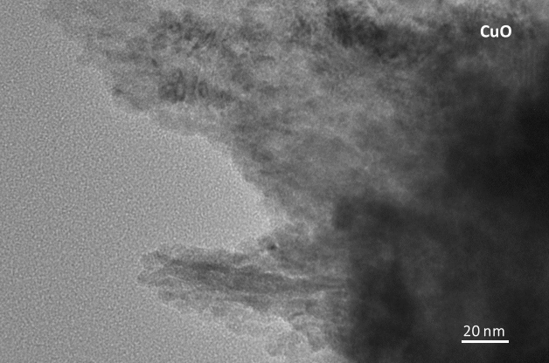
This shows the TEM of urchin copper oxide (CuO) nanostructures. The TEM image clearly shows the surface spikes with an average size of 25 nanometers.
Figure 2 . Morphology
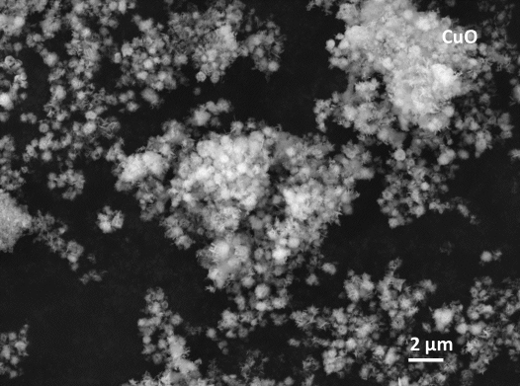
This shows the SEM of urchin-like copper oxide (CuO) nanostructures. The SEM image clearly shows the urchin-like surface morphology, highly monodisperse nanostructures with an average particle size of 250 nanometers.
Figure 3 . X-ray diffractogram (XRD) of urchin like copper oxide (CuO) nanostructure.
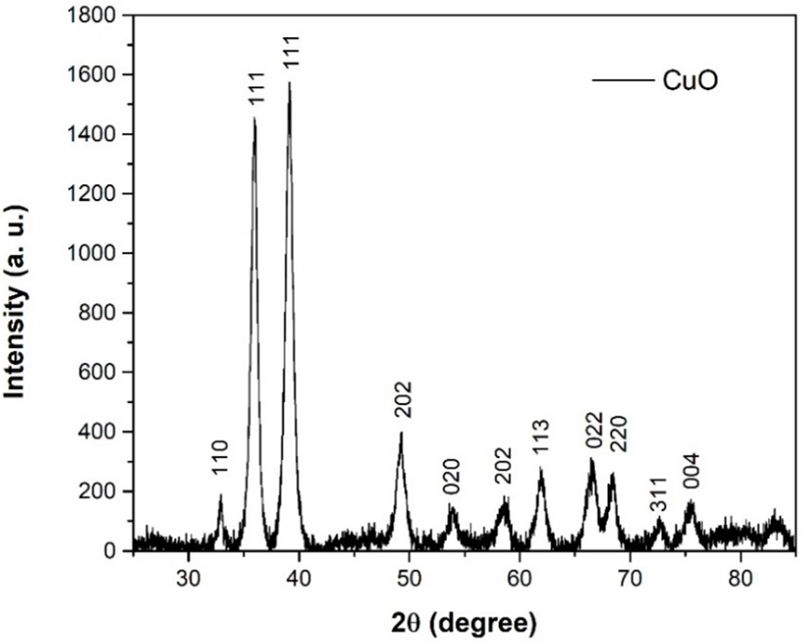
The XRD pattern confirms the crystalline nature of the material and matches the reference JCPDS card number 087125. No peaks of impurities are detected, indicating that the CuO nanostructures are pure.
Figure 4 . the energy dispersive X-ray (EDX) analysis of urchin like copper oxide (CuO) nanostructures.
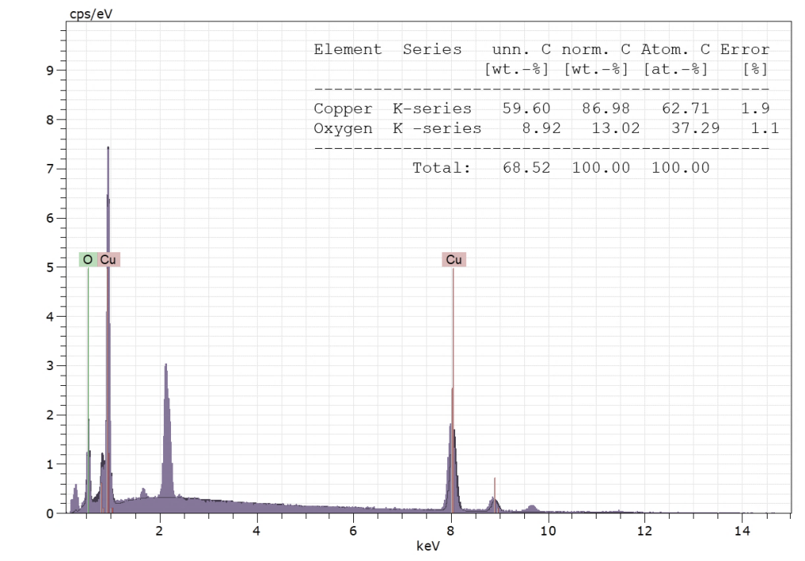
Urchin-like CuO nanostructures EDX spectra confirm the elemental presence of copper and oxygen. The EDX peaks at ~1.0 keV and ~8.0 keV energy could be assigned to CuK and peak at ~0.5 keV energy could be assigned to OK.
Conclusion
Summary: Key Points and Potential Impacts of the Protocol for Synthesizing Urchin-Like Copper Oxide Nanoparticles
This protocol focuses on the synthesis of urchin-like copper oxide nanoparticles (CuO NPs), a special nanostructure characterized by a central core with outward-growing needle-like or rod-like projections. This morphology is important because it provides a large surface area, more active sites, and improved interaction with surrounding molecules compared with regular spherical nanoparticles.
A key point of the protocol is the controlled formation of CuO nanoparticles through chemical synthesis conditions such as precursor concentration, pH, temperature, reaction time, and reducing or stabilizing agents. These parameters strongly influence the final size, shape, crystallinity, and surface properties of the nanoparticles. The urchin-like structure usually forms through nucleation followed by anisotropic growth, where CuO nanorods or spikes grow outward from a central point. Proper washing, drying, and calcination steps may also be included to improve purity and crystallinity.
The protocol is significant because copper oxide is a low-cost, easily available, and multifunctional metal oxide. Compared with noble metal nanoparticles, CuO nanoparticles are more affordable while still showing useful properties such as antimicrobial activity, catalytic behavior, semiconducting nature, and optical activity. The urchin-like morphology further enhances these properties by increasing surface exposure and improving charge transfer.
The potential impacts of this protocol are broad. In biomedical applications, urchin-like CuO nanoparticles may be useful for antimicrobial coatings, wound-care materials, biosensors, and anticancer research. In environmental applications, they can act as catalysts or photocatalysts for dye degradation, pollutant removal, and wastewater treatment. In energy and electronics, their semiconducting behavior makes them suitable for gas sensors, electrodes, batteries, supercapacitors, and solar-related devices. Their high surface area also makes them useful in chemical sensing and catalytic reactions.
However, the protocol also has limitations. Maintaining uniform urchin-like morphology can be difficult, and nanoparticles may aggregate if not properly stabilized. Some synthesis methods may involve toxic reagents, high temperatures, or careful pH control. Another major concern is nanotoxicity, as CuO nanoparticles can generate reactive oxygen species and may affect living cells, soil microbes, or aquatic organisms if released into the environment.
Overall, this protocol is valuable because it enables the preparation of a high-surface-area CuO nanostructure with strong potential in research, healthcare, environmental cleanup, sensing, and energy technologies. Its future impact will depend on improving reproducibility, scalability, green synthesis methods, and safety evaluation.
Conflict of Interest
The authors declare no conflict of interest.